00:00
Buy the album
- Spotify
- Apple Music
- Idagio
- Deezer
- Amazon Music
- Empik
A worthy salute to the Light
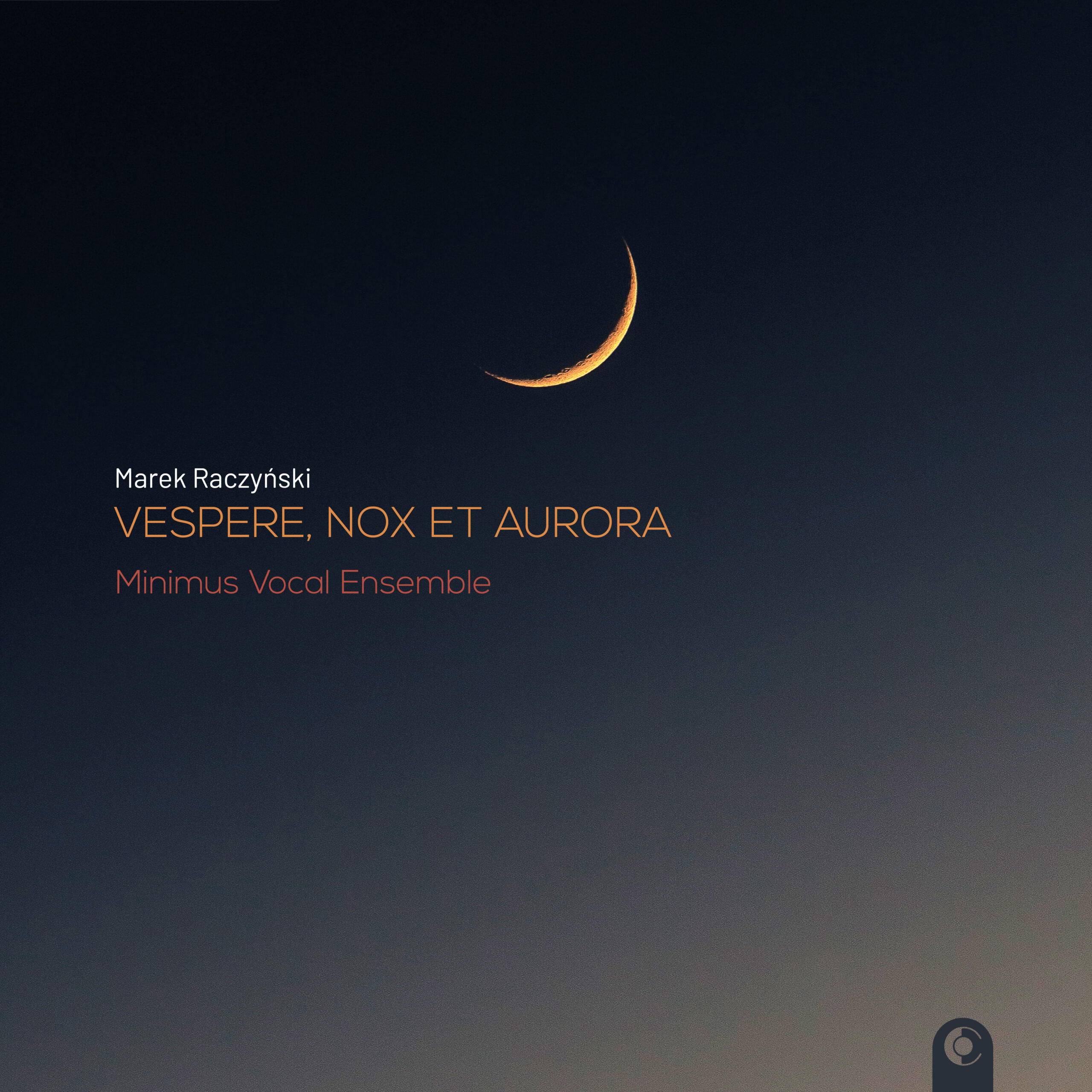
In the part devoted to the beginning of the world, the Bible says that God first created heaven and earth, formless and empty. Darkness was over the surface of the deep, and the Spirit of God was hovering over the waters. That is when God said: “Let there be light!” And day severed itself from night. That was the morning and evening of the first day. The album “Vespere, Nox et Aurora” (RecArt 0047) is a peculiar tribute to the light, to the immemorial order of the world in which night and day are not opposed to one another. They need each other, just as we do. However, the path towards the light is long and it requires facing oneself and the demons of the night. Although light and shadow are inseparable, we continue to fear everything that is unclear or invisible to us.
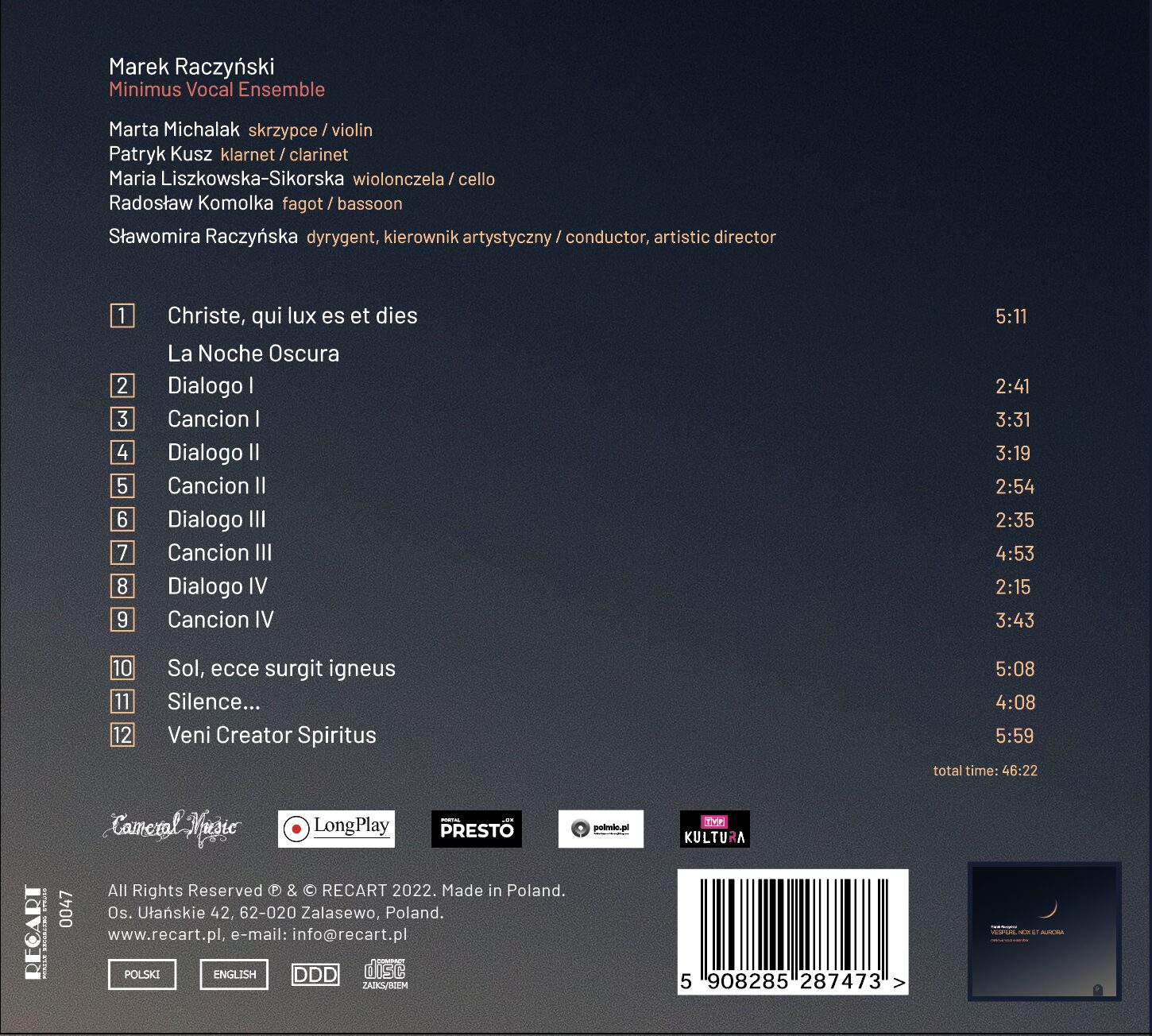
I tak otwierająca płytę kompozycja „Christe, qui lux est et dies”Thus, the opening composition, “Christe, qui lux es et dies”, was created to a fragment of the hymn from a Compline evening service. The piece, devoted to the memory of Wacław z Szamotuł, heralds the night. The lyrical melody of sopranos is laid softly upon repetitive sounds of the remaining voices, and as the piece approaches the end, it is filled with even more intriguing cluster consonances. They plant a seed of uncertainty within us and ask for a solution, which is nowhere to be found yet, since the pilgrimage through the night has only just begun.
The pillar of “La noche oscura”, the piece the lyrics of which have been kept in its original, Spanish version, is the mystical hymn of Saint John of the Cross. Instrumental parts serving as interludes (Dialogo) have been set up against vocal fragments (Cancion), while the story is based on love as an anchor in the darkness of the night and the power of it, bringing oblivion and making it possible to make it to sunrise. Vocal and instrumental parts are contrasted with each other, like two worlds – or day and night – where dream is interwoven with reality.
The next piece, “Silence...”, composed on commission for the Choir of the Centre for the Thought of John Paul II, allows the listener to reflect upon the creation of the world and the mysteries of light, spirit and nature. “Silence – why are you silent? How carefully you have hidden the secret of your beginning” – writes Saint John Paul II in the “Roman Triptych” cited above. The voices go from adding meaningful senses, reinforced by the recurring theme, to co-creating the harmony, deliberately tinted with unobvious interplays. As if, paradoxically, it was possible to hear something deeper in silence – like silence in which we can hear... silence. “Veni Creator Spiritus” is an impressive finale of the spiritual journey, inspired by the works of Stefan Stuligrosz. The composition includes a suspenseful beginning, an aleatoric final, quotes from a Gregorian chant and a memorable, ostinato-like rhythmic part sung by male voices. They overlap with descending triplets in female voices, creating an unforgettable impression of calling upon mortals begging for peace – thirsty of light in their own hearts. The concept of the album is very consistent and well-thought. It is a successful combination of early music and ambitions of contemporary music, chords with characteristic, thrilling semitones, quotations and thoughts drawn from literature. Despite the opulence of applied measures, the combination is engaging, reliable and honest.
Kolejny utwór, „Silence…”, skomponowany na zamówienie Chóru Centrum Myśli Jana Pawła II, pozwala zadumać się nad stworzeniem świata, sekretami światła, ducha i natury. „Cisza – dlaczego milczysz? Jakże starannie ukryłeś tajemnicę twego początku” – pisze św. Jan Paweł II w przytoczonym tu „Tryptyku Rzymskim”. Głosy raz dopowiadają istotne sensy, wzmocnione powracającym motywem, innym razem współtworzą harmonię, jakby celowo „przydymione” nieoczywistymi połączeniami. To tak jakby w ciszy paradoksalnie usłyszeć coś głębszego – niczym cisza, w której paradoksalnie słyszymy… ciszę. „Veni Creator Spiritus” to efektowne zwieńczenie duchowej podróży, czerpiące inspirację w twórczości Stefana Stuligrosza. W kompozycji tej znaleźć można pełny napięcia początek, aleatoryczny finał, cytaty z chorału gregoriańskiego i zapadającą w pamięć ostinatową rytmiczną partię głosów męskich. Nakładają się one na opadające triole w głosach żeńskich, tworząc niezapomniane wrażenie wołania śmiertelników, błagających o pokój – złaknionych światła na ich własnej drodze serca. Koncepcja płyty jest bardzo spójna i głęboko przemyślana. W udany sposób łączy tradycję muzyki dawnej z ambicjami muzyki współczesnej, harmonię z przyprawiającą o dreszcze, charakterystyczną sekundą, różnego rodzaju cytaty i myśli z literatury. A wszystko to czyni to w sposób ujmujący, a jednocześnie rzetelny i szczery.
Minimus Vocal Ensemble performing Marek Raczyński’s compositions sounds vibrant and soft. In each of the pieces it prepares us for what is inevitable, because (luckily for us) light possesses this very feature. We wander through the night, clad in sounds, along the astonishing and hesitant verge between evening and morning. We also hope to find a solution to tough and intriguing greys of our daily lives. Thus, the accompanying music brings us both reflection and consolation. On the other hand, gentle consonances with extended tonality naturally support us on our path to a new tomorrow. New meaning better? No matter what, it is certainly worth coming. text by Maja Baczyńska (translated by Maria Mordas)
Minimus Vocal Ensemble
Sławomira Raczyńska – conductor, artistic director
Marta Michalak – violin,
Patryk Kusz – clarinet,
Maria Liszkowska-Sikorska – cello,
Radosław Komolka – bassoon
Publisher: RecArt.
Release date: September 2022
Release date: September 2022